

 NUCLEAR PHYSICS SH2302
8 ECTS credits for F4
The course is also given as an introductory graduate course [5A5420, 6 credits]
|
|
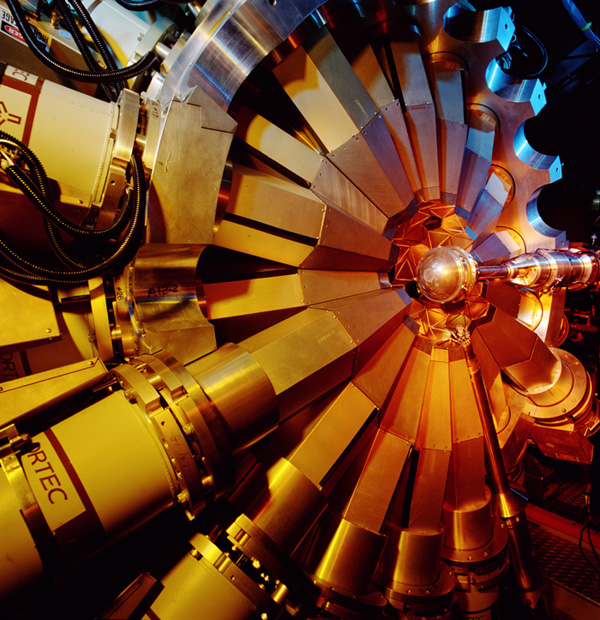
EXPERIMENT |
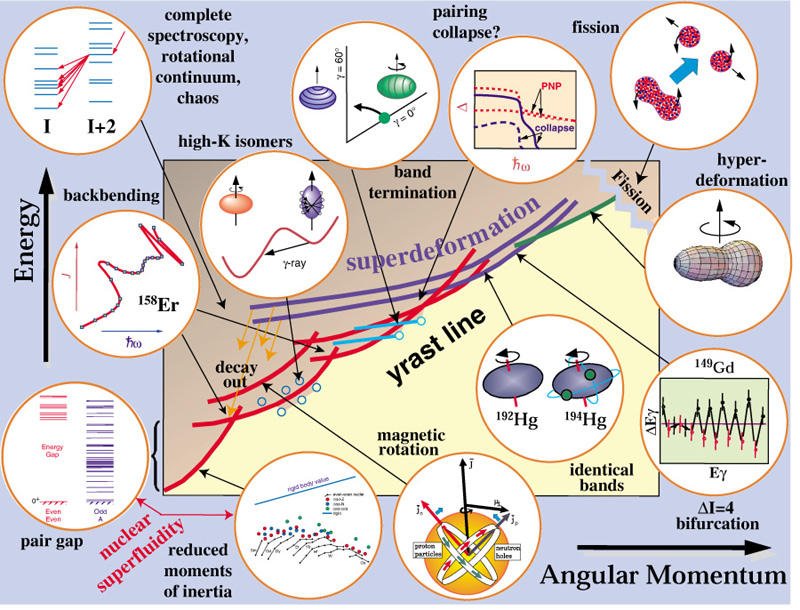
THEORY |
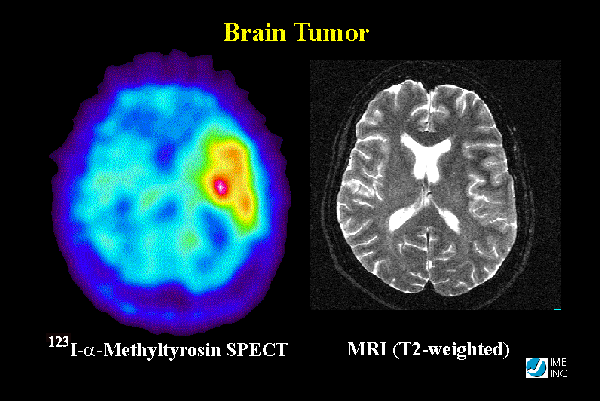
APPLICATIONS |
Lecturer and course
coordinator:
Prof. Bo Cederwall
Department of Physics,
Royal Institute of Technology
Roslagstullsbacken 21,
S-106 91 Stockholm , Sweden
(Centre for Physics, Astronomy and Biotechnology)
The course will cover selected topics in basic and applied nuclear
physics, such as:
· Basic nuclear properties
· The strong interaction -
alpha-decay
· The weak interaction -
beta-decay
· The electromagnetic
interaction - gamma-decay
· Nuclear reactions. Basic
scattering theory
· The quark model (in brief)
· The deuteron, effective
nucleon-nucleon interaction
· The nuclear shell model
and liquid drop model
· Deformed nuclei and collective
motion - rotations - vibrations
· Nuclear astrophysics - Big
Bang nucleosynthesis and star evolution
· Detectors for ionizing radiation
· Accelerators
· Fission and fusion - nuclear
energy production
· Applications of nuclear physics in
industry and medicine
The course will be given
during the spring semester, 2011.
Allowed
materials: Mathematical
Handbook (Råde and Westergren/Spiegel/Abramowitz
and Stegun or similar), calculator, writing
materials.
Course
schedule
Lectures start a quarter after the hour.
Lectures and laboratory exercises will take place
at AlbaNova, Roslagstullsbacken 21.
The lab work will be scheduled on an individual
(group) basis in order to, if possible, avoid collisions with other courses.
Do not enter the lab area without having carefully studied the radiation safety
information provided below!
Try to form groups of 3 students and contact the
laboratory assistants (see below) with the times when you would like to have
each laboratory excercise.
A list of possible lab times will be circulated in
connection with the lectures.
Lab # 5 is a computer lab in which the data from
the gamma-gamma coincidence measurement (lab # 4) is analyzed.
The lab manuals provided below must be studied
carefully before each lab in order to make efficient use of the time available.
Control questions may be asked by the lab assistant.
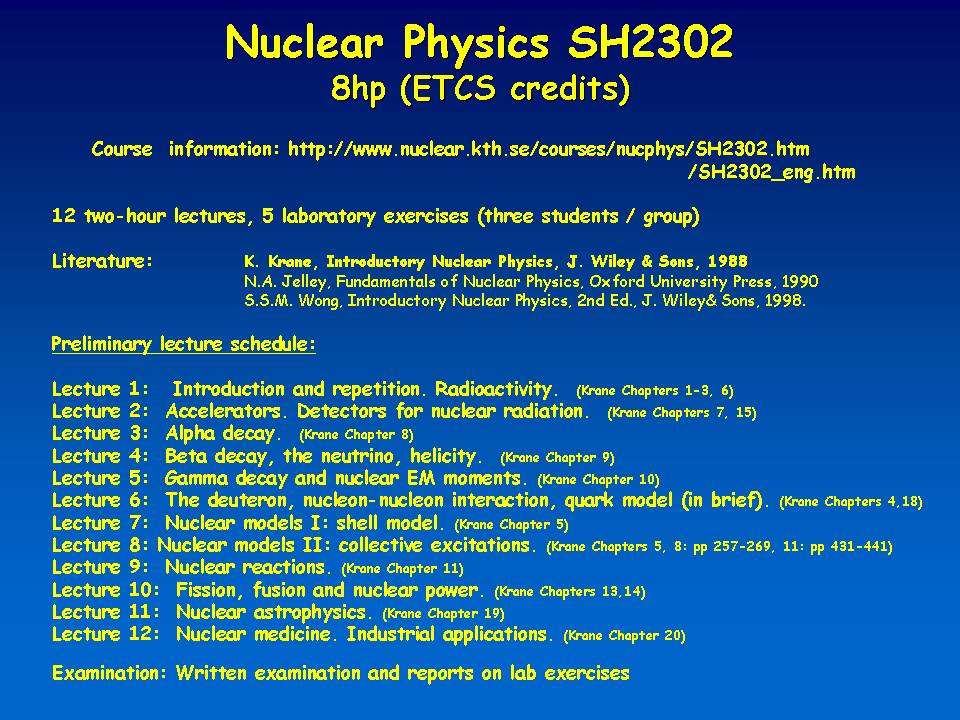
Preliminary
lecture itinerary
Laboratory exercises
· Radiation protection information
(To be studied
carefully before the first laboration!)
· Alpha decay and spontaneous fission.
· Principles
of radiation detectors. Internal conversion.
· Mössbauer effect. Measuring the natural linewidth of an excited nuclear state.
· Gamma-gamma coincidence measurement.
· Construction of a nuclear level scheme based
on the laboration Gamma-gamma coincidence
measurement.
SUGGESTED COURSE LITERATURE:
K. Krane, Introductory
Nuclear Physics, J. Wiley & Sons, 1988
N.A. Jelley, Fundamentals of Nuclear Physics, Oxford
University Press, 1990
S.S.M. Wong, Introductory Nuclear Physics, 2nd Ed., J. Wiley& Sons, 1998.
OTHER COURSE MATERIALS:
Lecture notes
Lab instructions
EXAMINATION will be in the form of a written examination and written reports from the laboratory work.
Grades are determined based on the result of the written examination.
All lab reports must be accepted, but they are not graded.
Grading scheme for the written examination:
E: At least 50% correct answers.
D: At least 60% correct answers.
C: At least 70% correct answers.
B: At least 80% correct answers.
A: At least 90% correct answers.
Fx: 40
– 49% correct answers
A few examples of interesting "popular" links:
ABC of nuclear physics
Glossary
Nuclear Science Wall
chart
Nuclear Physics at the femto-scale
(booklet on NP research in popular form)
Links to nuclear physics labs and resources:
Nuclear Physics Labs
RHIC, Relativistic Heavy Ion Collider
Lund Nuclear Data WWW
Service
Brookhaven National Lab databases
Stone table of nuclear
electromagnetic moments
Table of Isotopes WWW service
American Physical Society, Division of
Nuclear Physics
Nuclear Physics European Collaboration Committee (NUPECC)
European Infrastructure Network: Frontiers in Nuclear Physics
Illustration of a calculation of
q. m. barrier penetration using the WKB approximation
Nuclear Physics News Items, compiled by the
nuclear physics group, University of Liverpool
Nuclear Astrophysics:
Nuclear Astrophysics Data - LBNL
Nuclear Astrophysics - LANL
Radiation protection:
Swedish Radiation Safety Authority
Nuclear medicine:
Society for nuclear medicine
(USA)
Let's Play PET!
DIPLOMA WORK IN
NUCLEAR PHYSICS

CONTACTS:
Course coordinator and lecturer:
Bo Cederwall (phone 08-55378203)
Course assistants:
Anton
Khaplanov (55378199)
Farnaz Ghazi Moradi (55378199)
Last updated May 2009 / BC